


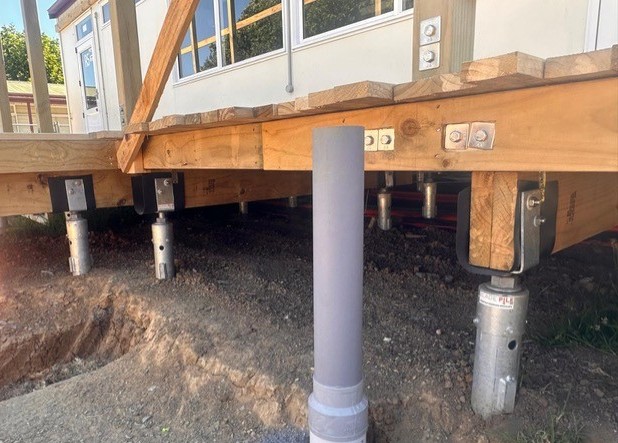


Since 15 January 2026, New Zealanders can build a small standalone dwelling of up to 70m² without a building consent, provided it meets the conditions of the new Schedule 1A exemption. It’s a big change, and we’re getting plenty of questions about how it works and where foundations fit in.
Here’s a plain-English guide to the process, and what you still need to get right underneath the build.
Does your granny flat qualify?
To be exempt, the dwelling must meet all of MBIE’s conditions. The key ones are:
- Single storey, standalone and self-contained – no mezzanine, detached from other buildings, for a single household
- 70m² floor area or less
- Simple design that meets the Building Code, with light timber or steel framing and lightweight roof and wall cladding
- Floor level no more than 1 metre above the supporting ground
- At least 2 metres from other residential buildings and legal boundaries
- Built or supervised by licensed practitioners (LBPs, registered plumbers, drainlayers and electricians)
MBIE’s building design conditions checklist has the full list. If your project doesn’t tick every box, a standard building consent is needed.
From 8 October 2026, updated rules also allow certified composite structural building products and clarify servicing requirements.
The process: before and after you build
Before building – apply for a PIM. The homeowner (or their agent or LBP) applies to the local council for a Project Information Memorandum using Form 2AA. A licensed designer can also include Form 2A (record of design work). The council assesses the application and issues the PIM, which gives its view on whether the project meets the exemption or needs a full building consent. Councils charge a fee for this – Auckland Council’s base fee is currently $520 (non-refundable, with extra charges possible). Check your own council’s current fee.
After building – notify council. Once the work is complete, the homeowner must notify the council and provide Records of Work and certificates from the licensed practitioners involved, within 20 working days of completion.
The PIM isn’t optional paperwork. It’s the formal step for council to make the consent-or-exempt call, and it creates the paper trail for your property. If the project changes during construction, for example it grows past 70m² or becomes more complex, it’s up to the owner to apply for a standard building consent.
Processes and forms can vary slightly between councils, so confirm the details with your council before you start.
Exempt from consent – not from the Building Code
This is the part that often gets missed. The exemption removes the consent step, not the requirement to comply with the Building Code. Your foundations still need to be designed and built to perform on your site.
Blade Piles are designed to AS 2159 and the Blade Pile Technical Design Manual, and they work for both types of site:
- Good ground: on NZS 3604 good ground, we sort the PS1 for you, so there’s no need to engage your own engineer. It keeps Blade Piles as simple as timber or concrete piles.
- Difficult ground: MBIE’s granny flats foundations guidance (August 2026) says sites with low-bearing or expansive soils, TC3 ground, peat or uncontrolled fill need specific engineering design. This is where Blade Piles come into their own. Our national network of engineers designs piles to reach a competent bearing layer below the weak soils.
Either way, you’ll receive a PS1 (design) from the engineer and a PS3 (construction) from the installer, either Blade Pile or your LBP builder. Keep these with your Records of Work as evidence your foundations meet the Building Code.
Why Blade Piles suit granny flats:
- End-bearing, not skin friction: the blade carries the load at the toe, below weak near-surface soils, unlike a ground screw that relies on shallow soil grip
- Capacity confirmed as you install: installation torque confirms each pile’s capacity on the day
- Quick to install: as little as half a day when only a few piles are needed. Every job is different, depending on pile numbers, ground conditions and access
- Clean: no concrete, no cure time and no spoil to cart away, ideal for established backyards
- Adjustable after installation: level-adjustable heads let the floor be set, and re-levelled later, without digging out or packing
- Suits sloping sites: piles can be installed to suit the slope, provided the floor stays within the 1 metre limit above ground
- Removable and reusable: ideal for relocatable buildings, or if land use changes in future
- Suits most ground: timber floors on TC1, TC2 and TC3 ground, subject to specific engineering design where required
Working with your builder
Choose the approach that suits your job. Every option uses the same engineered Blade Pile system:
- We install: a local, trained and certified Blade Pile installer does the job for you
- Your builder installs: LBP builders can be trained by Blade Pile and install with their own machine and drive gear
- Builder and civil contractor: your LBP builder and their civil contractor work together on the install, using gear they already have
- Hire our equipment: no gear? Your builder can hire Blade Pile’s installation equipment
There are no franchise or licence fees for builders installing our piles, so savings can be passed on to you. Whoever installs provides the PS3 and installation records to support the Record of Work.
Frequently asked questions:
Not if it meets every condition of the Schedule 1A exemption: single storey, standalone, self-contained, 70m² or less, simple design, and built or supervised by licensed practitioners. You still need a PIM from council before you start, and you must notify council when the work is complete.
Each council sets its own fee. Auckland Council’s base fee is currently $520, non-refundable, with extra charges possible. Check with your local council for its current fee.
Not always. Your foundations must meet the Building Code, even though the dwelling is exempt from consent. On NZS 3604 good ground, we sort the PS1 for you, so you don’t need to engage your own engineer. Where the ground is more difficult, our engineers provide a site-specific design and PS1.
You can still build. MBIE’s foundations guidance says sites with low-bearing or expansive soils, TC3 ground, peat or uncontrolled fill need a site-specific ground investigation and specific engineering design. Blade Piles are well suited to these sites because each pile is screwed down to a competent bearing layer below the weak soils, and installation torque confirms its capacity on the day.
Typically not. A PS4 is usually requested by council for consented work, and an exempt granny flat has no consent or council inspections. For the foundations, the engineer’s PS1 and the installer’s PS3 support your Records of Work.
Yes. LBP builders can be trained by Blade Pile and install Blade Piles themselves, using their own equipment or ours. There are no franchise or licence fees.
As little as half a day when only a few piles are needed. Every job is different, depending on pile numbers, ground conditions and site access. There’s no concrete, so there’s no cure time to wait for.
Yes, as long as the finished floor is no more than 1 metre above the ground. Blade Piles can be installed to suit the slope within that limit. If the floor needs to be higher, a building consent is required.
Talk to us early, ideally before you apply for your PIM, so your foundation design is sorted from the start. Get in touch for a design, a local certified installer, builder training or equipment hire.
This article is general guidance only and reflects MBIE and council information as at October 2026. Rules and processes may change and can vary between councils – always confirm requirements with your local council.