


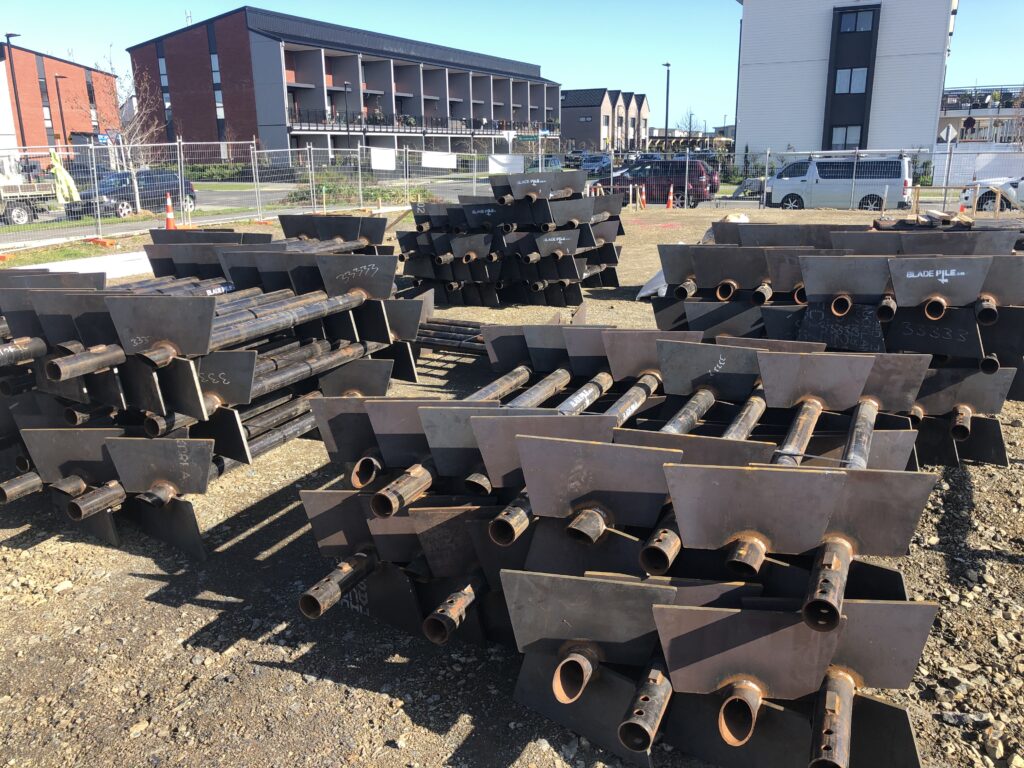
Every construction site is different, and choosing the right foundation starts with understanding your ground conditions. While conventional timber piles remain an excellent solution for many residential projects, some sites require an engineered foundation system such as Blade Piles to provide the safest, most practical and cost-effective outcome.
When are conventional timber piles the right choice?
If your site meets the NZS 3604 definition of “good ground,” conventional timber piles are often the most practical and affordable option. Good ground generally provides adequate bearing capacity and is unlikely to see excessive settlement over time, so for many new homes, decks and smaller residential buildings, timber piles continue to perform well. At Blade Pile NZ, we believe the right foundation is the one that suits the site. If timber piles are the most appropriate option, we’ll tell you—our goal isn’t to recommend Blade Piles for every project, it’s to give an honest assessment based on the conditions beneath your build. That said, even on good ground, some projects choose a screw pile subfloor for other reasons, such as the flexibility it offers for granny flats that may need to be adapted or removed in future.
When should engineered Blade Piles be considered?
Not every site has the benefit of good ground. Uncontrolled fill, peat, soft or compressible soils, liquefaction-prone ground, high groundwater and expansive clay can all fall outside the scope of NZS 3604 and require a more specialised foundation solution.
Engineered Blade Piles transfer building loads deeper into competent ground, making them well suited to sites where shallow foundations won’t perform, from a Napier build on uncontrolled fill to Rodney townhouses in expansive clay. They’re also an excellent option for house extensions, where managing differential settlement between the existing and new structure is an important design consideration, as in our recent Rotorua house addition.
Beyond ground conditions, Blade Piles are also used to bridge council services on tight or operational sites, for seismic strengthening of existing buildings, and on contaminated or archaeological sites where excavation isn’t an option.
A geotechnical report will usually identify whether your ground falls outside NZS 3604, letting your project engineer determine the best foundation system. Blade Piles are an AS2159-2009 compliant system, and more than 150 engineering companies across New Zealand are certified to design from our Technical Design Manual, so whichever foundation is right for your site, it can be specified with confidence.
If you’re unsure whether your project needs conventional timber piles or an engineered solution, ask the question early. Browse our Projects page for examples, or get in touch with the team to discuss your site.